Section governs the design
The rules that apply to your memorial are set by the section of the cemetery your grave sits in, not by the cemetery as a whole. Check the deed to confirm which section you own before commissioning any drawing.
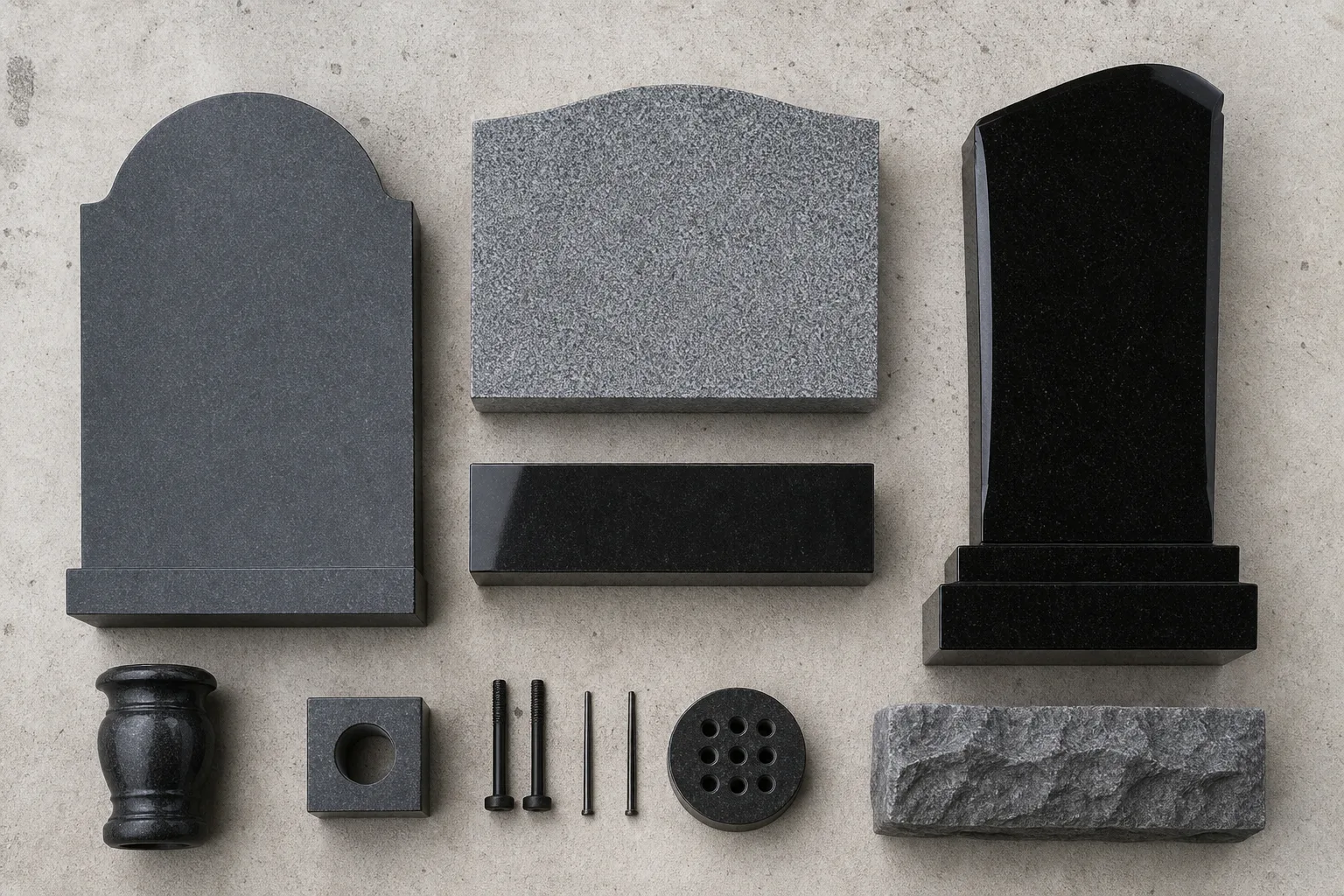
The rules that apply to your memorial are set by the section of the cemetery your grave sits in, not by the cemetery as a whole. Check the deed to confirm which section you own before commissioning any drawing.
A scaled drawing goes to the burial authority for sign-off before the granite is cut. Corrections at that stage cost nothing, while changes after lettering has been sanded in can mean a replacement stone.
Height limits are almost always stated from the top of the foundation or base to the highest point of the upright. A design over the limit by a single inch is refused on the same terms as one over by a foot.
Many grounds set a minimum thickness for a standing stone so that it resists being pushed over. Slender decorative slabs that look fine in a catalog are often rejected on stability grounds alone.
A monument company will take your order, take a deposit, and then send a scaled drawing to the burial ground for approval, and that is the moment a design either passes or comes back with corrections penciled across it. Nothing is wasted if the refusal arrives at the drawing stage. It becomes expensive later, once granite has been sawn to size and a name has been cut into it, because a stone shaped for one section will not always fit the rules of another. The careful reader checks the rules first and orders second.
A church-owned burial ground and a municipal or commercial cemetery are governed by different authorities, and their instincts pull in opposite directions. The churchyard is usually protected by a written policy adopted by the parish or diocese, conservative by design, favoring upright stones in traditional shapes and local materials. A city cemetery answers to an elected board or a public works department and tends to care most about mowing, drainage, and safety. Both will refuse work, but for unlike reasons: one on grounds of appearance and continuity, the other on grounds of maintenance and liability.
Within a single cemetery, the rules split again by section. An older section may allow uprights of generous height while a lawn section, sold later and priced lower, permits only a flush bronze or granite marker set level with the turf. The section is fixed by the deed you already hold, so the question worth asking before anything is drawn is which section your grave sits in and what that section allows, in writing.
Height limits are usually stated as an overall dimension from the top of the base to the highest point of the die, which is the upright stone itself, and a design that clears the limit by an inch is refused as readily as one that clears it by a foot. Base width is measured against the grave space, not the monument, and most grounds require a margin of undisturbed ground on each side. Where two graves are joined for a companion stone, the office will want the deed for both. Thickness matters too, since thin uprights are often rejected outright on stability grounds.
Granite and bronze pass nearly everywhere. Marble and limestone are frequently excluded in newer sections because they weather badly and grow illegible within a couple of generations. Sandstone is common in older churchyards and sometimes required there. What gets refused more often than the stone itself is the finish: high-gloss black polished on all faces, laser-etched photographic panels, gilding, applied porcelain portraits, colored fills, and reflective coatings all appear on exclusion lists, especially in grounds trying to keep one section visually consistent. Ceramic inserts and any component fixed with adhesive rather than doweled and pinned tend to draw the same objection.
Curb sets, meaning the low stone border that frames a full grave, along with corner posts, chippings, and enclosed gravel beds, are prohibited in most modern lawn sections and in many churchyards, because a mower cannot work around them and a loose curb becomes a trip hazard. Where they survive, they are usually grandfathered rather than newly permitted. Vases are the smaller battle. Many grounds allow one vase only, integral to the base or in a ground-set sleeve so it can be dropped below turf level, and glass, plastic, solar lights, benches, fencing and planted shrubs are commonly refused.
Inscriptions are checked as closely as dimensions. Church grounds often require plain lettering, no nicknames without the legal name alongside, and no wording that reads as a message to the deceased rather than a record of them. Trade names, team logos, brand marks and commercial insignia are refused for the obvious reason. Length matters, because a long verse crowded onto a small die will be rejected on legibility. Approve the inscription proof yourself, letter by letter, including dates and the spelling of every family name, since the Federal Trade Commission oversees how funeral goods are sold but no agency will pay to recut a stone.
Ask the office for the section rules and the application form on the same day you ask about the grave. Read them before you sit down with a monument dealer, bring them with you, and have the dealer note the governing limits on the drawing itself. A design built to the rules clears approval in one pass, and the stone goes up on the date you were given.